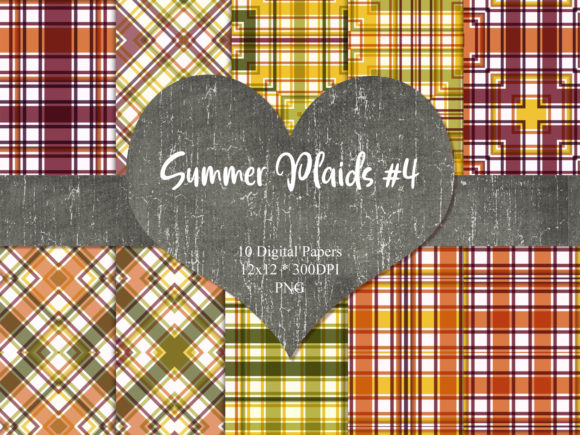
Summer Plaid 4: Versatile 12x12 Digital Papers for Creative Projects
If you’ve been looking for fresh, flexible design assets that work across both digital and physical crafting, Summer Plaid 4 is worth a close look. This collection brings together fun and funky geometric patterns in 12x12 inch 300 DPI PNG files — a format that practically begs to be printed, cut, layered, and shared. Whether you’re a seasoned card maker, a mixed media artist, or someone who runs a small creative business on the side, these digital papers offer a fast, consistent way to add personality to your work without starting from scratch every time.
Let’s walk through where these patterns shine, how different users actually put them to work, and what to keep in mind before you hit add to cart.
What Makes Summer Plaid 4 Different from Everyday Patterns
Summer Plaid 4 isn’t your grandmother’s plaid. The patterns lean into bold, lively geometry — think intersecting lines, checkerboard-like grids, and playful repeats that feel both retro and fresh. Each design is rendered at 300 DPI in a 12x12 inch square, meaning the resolution holds up whether you use a small snippet for a journal page or print it full-size for a scrapbook layout. Because they’re PNG files with transparent backgrounds in many cases (or fully opaque depending on the pack), you can drop them into virtually any software or print on demand setup without extra cleanup.
The “4” in the name often signals a volume or variation — here it likely refers to a specific set of colorways or pattern families. The key takeaway is that you’re getting a coordinated set, not a grab bag of mismatched prints. That coordination saves you time when you need multiple papers to work together on a single project.
Where Crafters Really Use These Papers
The most common question I hear is: “Okay, but what do I actually do with a 12x12 digital paper file?” The answer spans a lot more than you might expect.
Card Making
If you make birthday, thank-you, or seasonal cards, Summer Plaid 4 gives you pre-matched backgrounds that eliminate the “now what color goes with this?” pause. Print a sheet of the blue-and-white geometric plaid, cut it to card front size (usually 5x7 or 4.25x5.5), and layer a sentiment die-cut over it. Because the patterns are busy in a structured way, they work well as the main visual element — you don’t need to add much else. For a summer-themed card, pair one of the brighter plaids with a simple solid-color mat and a hand-stamped greeting. The 300 DPI ensures crisp edges when you cut with scissors or a trimmer.
Art Journaling
Art journaling is all about layering, and digital papers like these become instant texture. Print a full sheet, then tear or cut sections to glue into your journal as collage backgrounds. The geometric nature of Summer Plaid 4 adds a structured counterpoint to messy paint or ink splatters. If you work in a 9x12 journal, you can print at actual size (12x12) and trim, or scale down in your software. The PNG format means no loss of quality when you resize, as long as you keep the DPI at 300.
Junk Journal Assembly
Junk journal makers love finding “found” paper that looks deliberate. Summer Plaid 4 fits right into that aesthetic, especially if the colors lean slightly faded or vintage-inspired. Print several pages, sew them into signatures, or use single sheets as pockets, tuck spots, or belly bands. Because the patterns repeat seamlessly, you can cut narrow strips for spines or small tags without worrying about awkward seams. One practical tip: print onto a slightly heavier paper (like 60–80 lb text) so the inserts feel substantial when handled.
Die-Cutting Machines
If you own a Silhouette, Cricut, or similar die-cutting machine, 12x12 PNG files are nearly ideal. Import the design into your software, outline the pattern shape you want, and cut. The square format matches standard cutting mats, so you can use the entire sheet without wasted space. Use the printed paper to cut custom envelopes, box templates, or tiny embellishments like flowers and stars. Because the patterns are geometric, they cut well at small sizes — the lines stay recognizable even when reduced to an inch or two.
Mixed Media Art
Mixed media artists can use Summer Plaid 4 as a base layer on canvas or board. Print on lightweight paper, then adhere it with gel medium. Once dry, you can paint over parts, sand through to reveal the pattern, or add stenciled texture on top. The high DPI means if you decide to enlarge a section beyond 12x12 (say for a 16x20 canvas), you can upscale a bit in editing software and still keep acceptable sharpness. The key is to use the patterns as a starting point rather than a finished surface.
Collage Work
Collage artists often hunt for papers that have both color and linear structure. The plaids and geometric repeats in this collection give you ready-made elements for abstract or narrative collages. Cut out individual squares or triangles to build a mosaic effect, or use a full sheet as a background for a focal image. Because the patterns are bold, they work well when paired with neutral or monochrome imagery — think a sepia photograph on top of a vivid plaid.
How Different Users Benefit in Practice
The same set of digital papers can serve very different workflows depending on who you are.
Small business owners who sell handmade cards or journal kits can use Summer Plaid 4 to create consistent product lines. Instead of designing new patterns for each season, you can buy a set, print on demand, and maintain a cohesive look across your shop. Because the files are digital, you can offer custom color variations by adjusting hue/saturation in photo editing software — just be sure to check the license terms first.
Hobbyist scrapbookers will appreciate that 12x12 matches standard scrapbook page sizes. Print a few sheets of the same pattern to use across a whole album for visual continuity. The 300 DPI also gives you the option to print smaller inserts (like 4x6 journaling cards) and know they’ll line up cleanly with your larger pages.
Teachers and educators can repurpose these patterns for classroom materials — think bulletin board borders, name tags, or background paper for visual aids. The funky geometry catches students’ attention without being distracting. Print on cardstock and laminate for durability.
Digital creators and bloggers can use these PNGs as seamless backgrounds for social media graphics, blog post headers, or printable planners. The 12x12 inch size at 300 DPI translates well to 1080x1080 pixels for Instagram squares or 1200x628 for Pinterest pins, though you’ll want to resize with care to avoid artifacts.
What to Consider Before You Buy or Download
Before you start printing or cutting, think through a few details to avoid frustration.
- File format and transparency. Check whether the PNGs in your specific Summer Plaid 4 pack have transparent backgrounds. If they’re fully opaque with a white or colored background, that’s fine for most print uses, but for digital overlays or layered compositions, transparency is a big time-saver.
- Color accuracy. The patterns look vibrant on screen, but printer calibration varies. Print a small test swatch before committing to a full sheet, especially if you’re selling final products. Some users find that adjusting brightness slightly in Photoshop or GIMP gives more true-to-life results.
- Commercial use rights. If you plan to sell items made with these papers, read the license carefully. Some digital paper sets allow unlimited commercial use, others limit the number of products or require credit. Summer Plaid 4 likely falls under standard crafting licenses — just double-check so you don’t run into issues later.
- Paper weight and printer compatibility. For cards or journal covers, you may want to print on 80–100 lb cardstock. Most home inkjet printers handle that weight, but laser printers might jam with heavier stock. For die-cutting, lightweight paper (20–24 lb) works best for intricate cuts, so plan accordingly.
- Scaling and cropping. The files are exactly 12x12 inches at 300 DPI. If your project uses a different aspect ratio (like A4 or letter size), you’ll need to crop or scale. That’s easy in any image editor, but keep the original file backed up so you can re-export without quality loss.
Realistic Workflows That Save Time
Instead of treating Summer Plaid 4 as a one-off purchase, think of it as a building block. For example, create a master digital folder with the PNG files, and each time you start a new project, open the folder and drag in the closest color match. Over a month, you’ll find yourself reaching for the same few patterns — that’s normal. The beauty of a coordinated set is that even if you only use two or three of the designs consistently, the rest are there when you need a contrast or a surprise.
Another practical workflow: batch print a few sheets of your favorite patterns at once, then store them in a protective sleeve. When inspiration strikes, you have ready-to-use backgrounds without turning on the printer. This works especially well if you make cards or journal pages in batches — print once, create multiple projects.
Making the Most of Geometric Patterns Without Overdoing It
One of the biggest challenges with bold patterns is knowing when to stop. Summer Plaid 4’s funky geometry is eye-catching, but if you use it on every surface of a project, the result can feel chaotic. A good rule of thumb: use the pattern on one main element (background, feature panel, or accent strip) and keep surrounding elements neutral or simple. For a junk journal page, for instance, use a plaid paper as the backing for a window or pocket, then pair it with plain cardstock, a vintage image, and text. That way the pattern stays the star without overwhelming the composition.
If you’re working digitally, you can also reduce the opacity of the paper layer to 50–70% and overlay it on a solid color. That gives you a subtle texture rather than an in-your-face print. This technique is popular among bullet journalers who want a watermark-like background for monthly spreads.
Final Thoughts on Adding Summer Plaid 4 to Your Tool Kit
Summer Plaid 4 fits naturally into the workflow of anyone who values ready-made design quality without the overhead of creating patterns from scratch. Whether you’re printing for a physical project, cutting with a machine, or layering in a digital file, the 12x12 inch 300 DPI PNG format gives you professional-grade flexibility. The key is to use it with intention — match the pattern to the purpose, prepare your materials in advance, and let the geometry do the heavy lifting. Start with one project, see how the patterns behave in your specific setup, and you’ll quickly know how many more uses you can find.