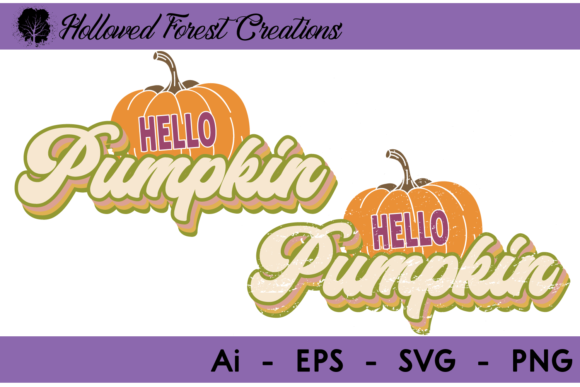
Hello Pumpkin – Vintage Design Set: A Deep Dive into Versatile Digital Crafting
Digital crafting has evolved far beyond simple clip art. Today’s creators demand assets that are not only beautiful but also adaptable, editable, and ready for a wide range of production methods. The Hello Pumpkin – Vintage collection delivers exactly that, offering a thoughtfully curated set of design files built around a warm, nostalgic autumn aesthetic. Whether you are a print-on-demand seller, a home decor enthusiast, a textile designer, or a graphic artist looking for reliable base assets, this bundle provides the flexibility and quality needed to bring your visions to life efficiently.
At its core, the set includes SVG, EPS, AI, and PNG formats for each design, all packaged into a single compressed .zip folder for easy download and organization. This multi-format approach ensures that no matter which software ecosystem you prefer—Adobe Illustrator, CorelDRAW, Affinity Designer, Inkscape, or even a cutting machine interface like Cricut Design Space or Silhouette Studio—you have a file type that works natively. The PNG variant also serves those who need a quick raster preview or a ready-to-use transparent image for mockups or digital scrapbooking.
What makes Hello Pumpkin – Vintage particularly compelling is the balance it strikes between a nostalgic, hand-drawn feel and the technical precision required for modern production. The vintage aesthetic is rendered in clean vector paths, meaning you can scale any element from a tiny tag to a large-format wall mural without any loss of sharpness. The four-file-per-design structure also means you are never locked into a single workflow; you can edit the vector source files, export to new formats, or simply drop the PNG into your layout tool of choice.
Understanding the File Formats and Their Real-World Roles
To make the most of this collection, it helps to understand what each format brings to the table and when to reach for one over another. Each design in the Hello Pumpkin – Vintage set is provided in four distinct file types, each serving a specific stage of the creative pipeline.
- SVG (Scalable Vector Graphics): This is the go-to format for web use, cutting machines, and quick edits in browser-based or lightweight design tools. Because SVG files are written in XML, they can be opened in a text editor for manual tweaks, and they preserve layering and color information very well. For Cricut or Silhouette users, SVG is often the most straightforward import option, allowing you to separate elements for different colored materials.
- EPS (Encapsulated PostScript): A staple in professional print and graphic design, EPS files are widely supported by legacy and high-end design software. If you work in a print shop or a studio that uses older versions of Adobe software, EPS ensures backward compatibility. It also handles complex vector paths and embedded raster previews gracefully, making it a reliable choice for large-format printing and sign making.
- AI (Adobe Illustrator): For designers who live inside Illustrator, the native AI file format is the most editable version. All layers, grouped elements, color swatches, and effects are preserved exactly as the designer intended. This means you can open the file, unlock a layer, recolor a pumpkin or a leaf, adjust stroke weights, or add your own typography in seconds. No conversion necessary, no formatting lost.
- PNG (Portable Network Graphics): The PNG is your ready-to-use raster version, typically with a transparent background. This is incredibly useful for quick mockups, social media graphics, or for users who do not have vector editing software. It is also the format of choice for sublimation printing workflows where you simply need a high-resolution image with a clean alpha channel.
Having all four formats in a single .zip folder eliminates the need to convert files yourself, saving time and reducing the risk of quality degradation. The moment you unzip the folder, you have a complete toolkit for any project stage—from concept and editing to final production.
Editing and Customization: Color Changes and Beyond
One of the strongest selling points of the Hello Pumpkin – Vintage set is how easy it is to edit. The vector files are built with clean, closed paths and logical grouping, which means changing colors is a matter of selecting a shape and applying a new fill. You do not need to be a seasoned graphic designer to achieve professional results; even basic familiarity with software like Inkscape (free) or Canva’s vector editing capabilities can yield dramatic customizations.
For example, a design that features a classic orange pumpkin with warm brown stems and sage green leaves can be recolored to match a specific brand palette, a seasonal collection, or even a monochrome look for a minimalist aesthetic. You could invert the colors, soften them to pastels for a baby shower, or deepen them into rich burgundy and gold for a luxurious fall wedding invitation. The ease of editing extends beyond color: you can also resize individual elements, rotate leaves, duplicate pumpkins, or combine multiple designs from the set into a single composition.
This level of customization is especially valuable for businesses that produce multiple product variations from the same base artwork. A single Hello Pumpkin – Vintage design can be adapted for a coffee mug, a tote bag, a throw pillow, and a phone case, each with a different color scheme tailored to the product and audience. The ability to iterate quickly without starting from scratch is a clear advantage in a fast-paced market.
Practical Workflows for Sublimation and Apparel
Sublimation printing has exploded in popularity thanks to its vibrant, all-over color capabilities and durable finish. For sublimation, the PNG file is often the most direct route: simply open the transparent PNG in your sublimation design software (like Sawgrass Print Manager, Epson Print Layout, or even Photoshop), place it on your template, and print onto sublimation paper. The transparent background ensures that the design sits cleanly on the substrate without a white border.
However, the vector files (SVG, EPS, AI) offer even more control for sublimation because you can adjust the saturation, hue, and contrast of individual shapes before rasterizing. This is particularly useful if you are printing on polyester fabric blends where the color outcome can shift slightly depending on the heat press temperature and fabric chemistry. By fine-tuning the vector colors and then exporting a high-quality PNG, you achieve more predictable and consistent results.
For apparel such as t-shirts and hoodies, the same files can be used for screen printing, heat transfer vinyl, or direct-to-film (DTF) applications. Screen printers, for instance, can open the EPS or AI file to separate colors into individual layers, create films, and burn screens. The clean vector lines ensure sharp edges even on fine details like thin stems or small text elements. Heat transfer vinyl users can load the SVG into their cutting machine, weed the design, and press it onto garments with confidence that the intricate cuts will hold together.
Beyond Apparel: Wall Art, Home Decor, and Fabric Patterns
The versatility of Hello Pumpkin – Vintage extends far beyond clothing. Wall art is a natural application: the vintage aesthetic fits beautifully into farmhouse, rustic, and modern country decor styles. You can scale a single design to poster size and print it on canvas or fine art paper, or you can create a gallery wall of multiple pumpkin-themed prints in coordinating colors. Because the vector files are resolution-independent, you are limited only by your printer’s maximum media size.
Fabric patterns are another exciting use case. With the AI or EPS files, you can arrange one or more pumpkin motifs into a repeating tile and generate a seamless pattern. This pattern can then be printed on cotton, linen, or polyester through a custom fabric printing service. Imagine a continuous pumpkin vine pattern on a table runner, a set of napkins, or a quilting fabric. The ease of recoloring means you can produce a series of coordinating fabrics—a bold orange version for autumn, a muted sage version for year-round use, and a dark charcoal version for a moody, modern look.
For home decor items like throw pillows, ceramic mugs, coasters, and enamel pins, the PNG file often serves as the final production asset, but having the vector sources allows you to experiment with scale and cropping without losing quality. A pumpkin motif that looks great centered on a round coaster might need to be offset or repeated on a rectangular doormat. With editable files, such adaptations take minutes rather than hours.
Who Benefits Most from This Design Set?
The Hello Pumpkin – Vintage bundle is designed to serve a remarkably broad audience. Understanding who uses these files and how they integrate them into their workflows can help you see where this collection might fit into your own projects.
- Print-on-Demand Sellers: Speed and consistency are everything. Having 4 files per design means you can instantly load a PNG into your POD platform (like Printful, Printify, or Redbubble) or edit the AI file to match a specific product’s bleed and trim requirements. The vintage aesthetic also aligns well with seasonal campaigns, especially fall and Halloween.
- Small Business Owners and Crafters: If you sell at local markets or run an Etsy shop, the ability to quickly produce multiple products from a single design reduces overhead. You can print your own sublimation blanks, cut heat transfer vinyl for tote bags, and create handmade cards—all from the same source files.
- Graphic Designers and Illustrators: Even experienced designers sometimes need a reliable starting point. The Hello Pumpkin – Vintage set can serve as a base for client projects, mood boards, or as part of a larger composition. The clean vector construction means you can modify it heavily without fighting the file structure.
- Educators and Hobbyists: Teaching design principles? The SVG and AI files are excellent for demonstrating vector editing, color theory, and layering. Hobbyists who enjoy digital scrapbooking, card making, or bullet journaling will find the PNG files immediately useful for print-and-cut projects.
- Researchers and Content Creators: If you are creating instructional content about design workflows, file formats, or sublimation techniques, having a real-world asset like this set allows you to show before-and-after edits, compare raster vs. vector output, and demonstrate best practices in a concrete way.
Considerations When Using Multi-Format Design Sets
While a four-file-per-design bundle offers immense flexibility, there are a few nuances worth keeping in mind to get the best results. First, always inspect the layer structure in the AI and EPS files before making heavy edits. Some designers group elements differently; understanding the grouping will save you time when you want to recolor only specific parts. Second, while PNG files are convenient, they are raster images and have a fixed resolution. The PNGs included in this set are typically high-resolution, but if you need to print at very large sizes (over 24 inches), it is better to use the vector files to export a custom-sized PNG at the precise DPI you need.
Another consideration is color management. The colors you see on your monitor may shift during printing, especially with sublimation or screen printing. It is always wise to run a test print before producing a large batch. The ease of color editing in the vector files means you can calibrate your design based on test results without redoing the whole layout. Also, be aware that some free software may not fully support all features of EPS or AI files; if you encounter issues, the SVG format is often the most universally compatible option.
Finally, think about file organization. Since the assets come in a single .zip folder, you may want to create your own folder structure—for example, by format, by color variant, or by project—to keep everything manageable as your library grows. This is especially important for businesses handling dozens of designs across multiple seasons.
Why Vintage Aesthetics Endure in Design
The Hello Pumpkin – Vintage name is not just descriptive; it taps into a broader trend that has proven remarkably durable. Vintage and retro designs evoke nostalgia, warmth, and a sense of handcrafted authenticity that resonates across generations. In an era of digital saturation, people are drawn to artwork that feels grounded, organic, and reminiscent of simpler times. The pumpkin itself is a universally recognized symbol of harvest, comfort, and seasonal celebration, making it a versatile motif that works from September through November and beyond, especially in rustic and farmhouse decor contexts.
From a design perspective, vintage aesthetics often incorporate earthy color palettes, subtle texture cues, and slightly imperfect, hand-drawn linework. The vector files in this set capture that character without sacrificing clean geometry. The result is a design that prints beautifully on modern substrates while retaining a timeless, handmade charm. This combination of old-world feel and modern technical reliability is exactly what makes such assets valuable for both limited edition projects and ongoing product lines.
Bringing It All Together: A Flexible Foundation for Creative Work
Whether you are preparing a fall collection for your online store, designing custom gifts for a holiday market, or simply exploring new creative techniques, the Hello Pumpkin – Vintage design set provides a robust starting point. The inclusion of SVG, EPS, AI, and PNG files for each design, delivered in a single .zip folder, removes friction from your workflow and gives you the freedom to work in the software and export format that best suits each project. The ease of color editing means that a single design can become ten different products across multiple colorways, and the vintage aesthetic ensures broad appeal in a marketplace that consistently rewards warm, nostalgic imagery.
By investing a few minutes to understand how each format behaves in your specific software and production method, you can unlock the full potential of these assets. Experiment with scaling, layering, recoloring, and combining elements from different designs in the set. The more you explore, the more you will discover how a well-constructed vector asset can serve not just one project, but an entire creative practice. Hello Pumpkin – Vintage is not merely a collection of files; it is a versatile tool that adapts to your vision, rather than limiting it.